If you buy raw jute fibre, the grade on the bale mark decides almost everything about what you can make from it and what you should pay. But the grading language — Tossa and white, BTR and BWR, grades A through D — is opaque until someone lays it out. This guide explains the two fibre types, the grading systems used for Bangladeshi jute, and the properties that separate a top grade from a low one, so you can specify and check what you buy.
Bangladeshi raw jute is either Tossa (Corchorus olitorius) or White (Corchorus capsularis), classified in export as Bangladesh Tossa (BTR) and Bangladesh White (BWR) and graded A to D. Grade is set by strength, colour and lustre, root content, fibre length and defects.
Two kinds of jute: Tossa and White
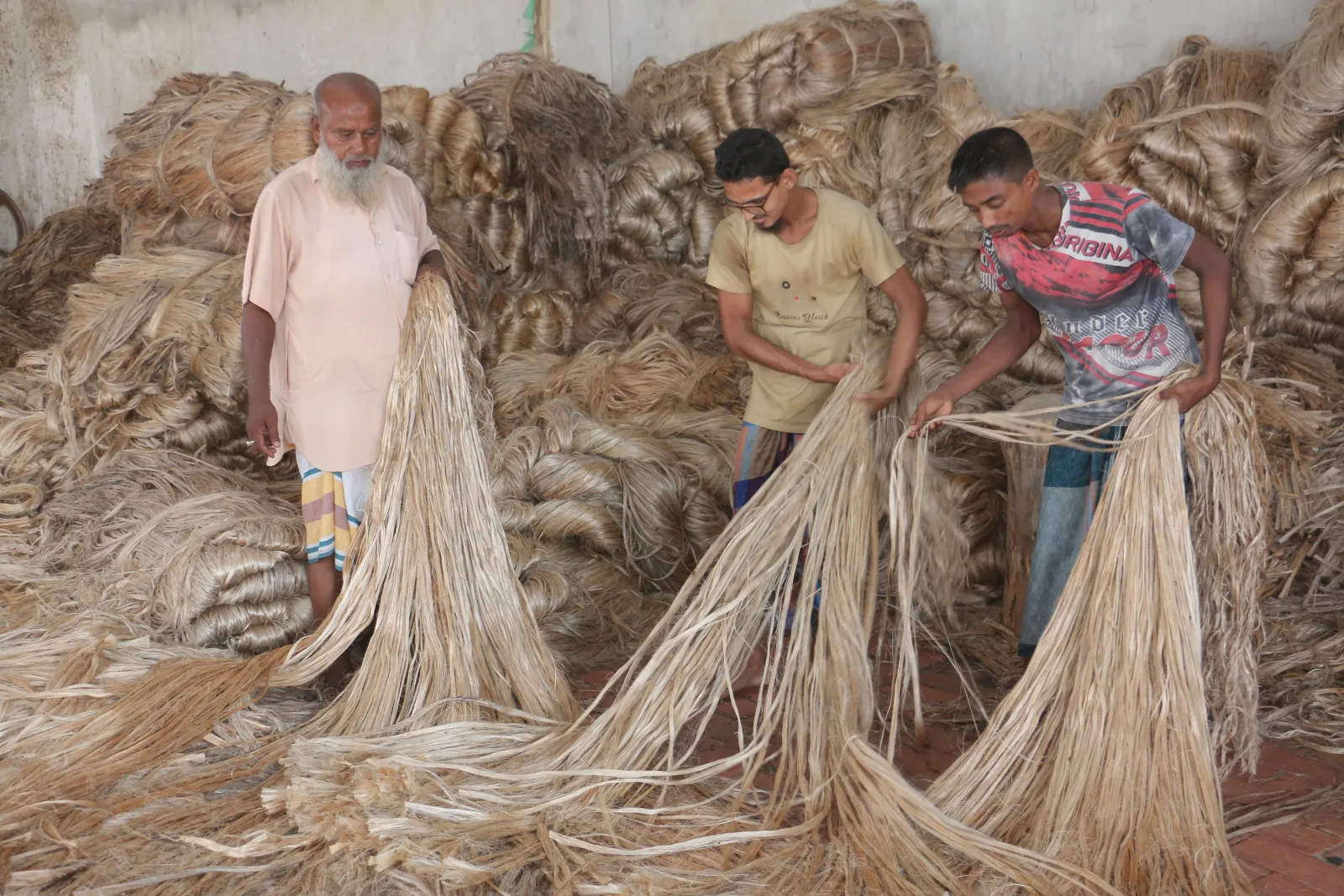
Bangladesh grows two commercial jute species. Tossa jute (Corchorus olitorius) is the premium fibre — longer, stronger, softer and with a richer golden colour — and makes up the majority of the crop and the exports. White jute (Corchorus capsularis) is generally a little coarser and whiter in tone. Most buyers of spinning-grade fibre want Tossa; White has its own uses and price point. For the wider quality context, see jute yarn types, grades and quality.
The grading systems: BTR and BWR
In the export trade, Tossa fibre is classified as BTR (Bangladesh Tossa) and White fibre as BWR (Bangladesh White), each divided into grades — commonly A, B, C and D (with special/premium selections above A for the finest lots). The grade is assigned by trained classers who judge several properties together, against the Bangladesh Standard specifications for jute fibre. It is a holistic assessment: a bale is not Grade A because of one number, but because strength, colour, cleanliness and length all meet the mark.
What the classers judge
- Strength — the single most important property; higher grades are notably stronger, which sets the ceiling for yarn strength.
- Colour and lustre — bright, uniform golden fibre grades higher than dull, grey or off-shade fibre.
- Root content — the hard, woody root ends are a defect; less root means a higher grade.
- Fibre length — longer, more uniform staple grades higher and spins finer.
- Defects — specks, knots, hard centre, barky bits and cuttings all pull the grade down.
- Cleanliness and moisture — well-retted, clean, properly dried fibre grades better than gummy, over-wet or heated fibre.
Tossa (BTR) grades at a glance
| Grade | Strength | Colour & lustre | Root & defects | Typical use |
|---|---|---|---|---|
| BTR-A | Very strong | Bright golden, high lustre | Very low | Fine, high-count yarn; premium export |
| BTR-B | Strong | Good, fairly uniform | Low | General yarn, hessian warp |
| BTR-C | Medium | Fair, some off-shade | Moderate | Sacking yarn, coarser counts |
| BTR-D | Lower | Duller, mixed | Higher | Low-count yarn, sacking, blending |
White (BWR) grades at a glance
| Grade | Strength | Colour | Root & defects | Typical use |
|---|---|---|---|---|
| BWR-A | Strong | Clean, creamy white, good lustre | Very low | Better white-jute yarn |
| BWR-B | Fairly strong | Fair white | Low | General yarn and fabric |
| BWR-C | Medium | Mixed tone | Moderate | Sacking, coarser goods |
| BWR-D | Lower | Off-shade, uneven | Higher | Sacking, blending, low-count |
Why grade matters to your product and price
Grade cascades all the way through. Stronger, cleaner, longer high-grade fibre spins into stronger, finer, more even yarn with less waste; low-grade fibre limits how fine and strong the yarn can be and puts more defects into whatever is made from it. Grade is also the main driver of price, so buying a grade higher than your product needs wastes money, and buying a grade lower than it needs costs you in quality and yield. The right move is to match the grade to the end use — and to state the grade explicitly on every order.
How to specify and verify raw jute fibre
- State the type and grade you want (e.g. BTR-B Tossa), not just 'good quality jute'.
- Ask about strength, root content and staple length for that grade, and the moisture at delivery.
- Confirm baling, packing and that the fibre is clean, well-retted and properly dried.
- For critical orders, agree independent inspection — see how testing works in our jute quality testing guide.
FAQ
What is the difference between Tossa and White jute?
Tossa (Corchorus olitorius) is longer, stronger, softer and more golden — the premium spinning fibre. White (Corchorus capsularis) is generally coarser and whiter. Most spinners prefer Tossa.
What does BTR or BWR mean?
BTR is Bangladesh Tossa and BWR is Bangladesh White — the export classifications for the two jute types, each graded (commonly A to D) by strength, colour, root content, length and defects.
Which grade of raw jute do I need?
It depends on your product: higher grades (A/B) for finer, stronger yarn; lower grades (C/D) for sacking, coarse goods or blending. Match the grade to the end use to avoid overpaying or underspecifying.
Buy graded raw jute fibre from Bangladesh
We supply raw jute fibre — Tossa and White, in export grades — baled and documented, mill-direct from Khulna. Tell us the type, grade and volume you need and we will quote with full bale specs: request a quote.